[Updated] LG Display Announce a New 27″ 4K OLED Panel with RGB-Stripe Layout
Originally published 23 December 2025, last updated 28 May 2026 (mass production schedule)
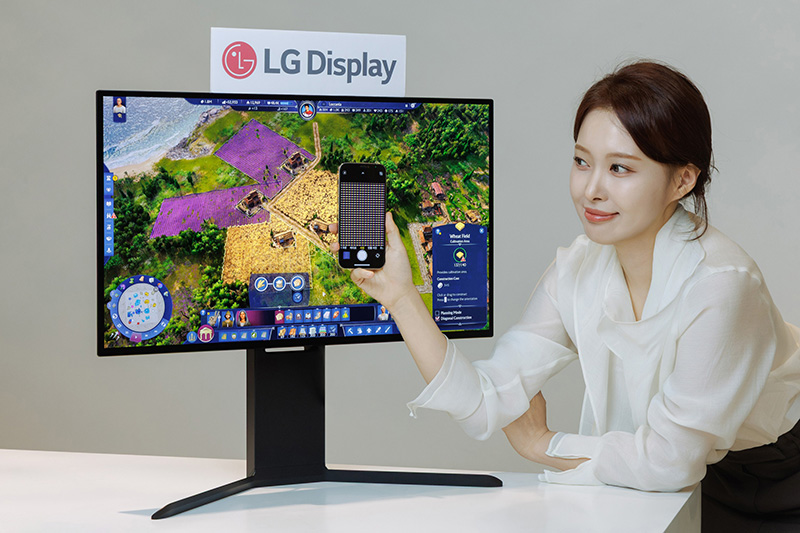
OLED panel manufacturer, LG Display today (23 Dec 2025) announced some further details of one of their new panels which was teased a couple of days ago in a promotional video (along with other new updates). The newly announced OLED panel offers a 27″ screen size, with a 3840 x 2160 “4K” resolution and a 240Hz refresh rate. This is the first time they’ve produced a 27″ 4K panel, following on from Samsung Display’s competing QD-OLED panel released in 2025.
This LG Display panel also offers support for a “dual-mode” function which allows you to double the refresh rate to 480Hz, at a lower 1080p resolution. Most interesting of all is the switch to a true RGB-stripe sub-pixel layout, doing away with the white sub-pixel and helping to improve text clarity and reduce fringing.
True RGB stripe layout
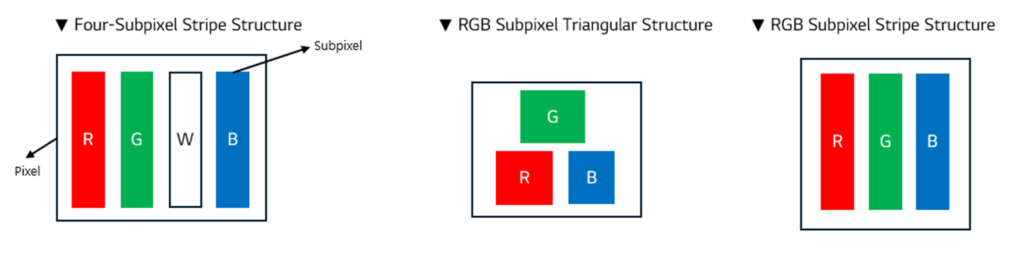
The RGB stripe sub-pixel structure arranges the three primary colour subpixels — red, green, and blue — in a straight line, significantly reducing visual distortions such as colour bleeding and fringing, even at close viewing distances. This is a change from their earlier “WOLED” panels which had an added white sub-pixel which was used for boosting brightness. In the past the earlier WOLED panels were arranged in an RWBG layout, but this was later updated and improved somewhat to RGWB with some of their newer panels.
We’d already seen significant improvements in text clarity on competing QD-OLED panels of this size and resolution, and although the increased pixel density alone would likely have solved most lingering issues anyway, it’s great to see LG Display just shift to a true RGB-stripe layout with the new panel. This structure is “optimized for operating systems such as Windows and for font-rendering engines, ensuring excellent text readability and high colour accuracy”.
LG Display mention a pixel density of 160 PPI in the press release, although [now confirmed] the actual panel size remains the same as previous 27″ class monitor panels at 26.5″, it is actually ~166 PPI in reality. Although OLED panels using the RGB stripe method existed before (e.g. the professional-focused monitors featuring panels from JOLED), their maximum refresh rate reached around 60Hz, making them unsuitable for use as gaming monitors.
High refresh rate
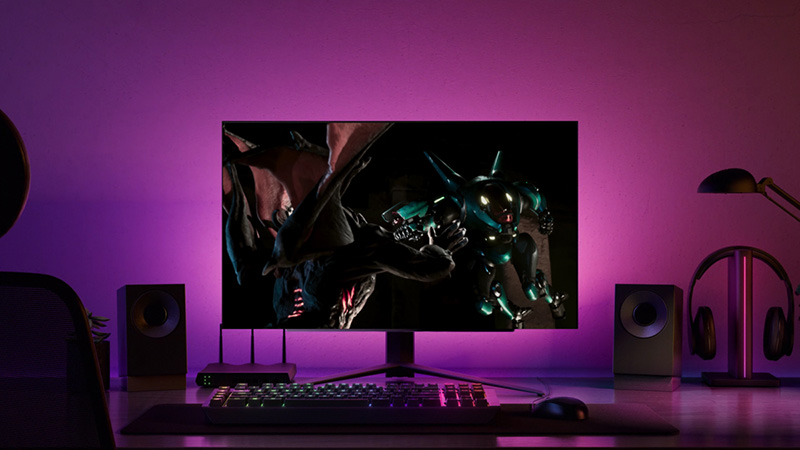
LG Display’s new panel is the first in the world to achieve a 240Hz refresh rate while maintaining an RGB stripe structure. It incorporates the company’s specialized Dynamic Frequency & Resolution (DFR) technology (“dual-mode”), allowing users to directly switch between high-resolution (UHD 240Hz) and high-refresh-rate (FHD 480Hz) modes.
They explain that as they “developed [their] new pattern optimized for monitor use, it applied various new technologies — such as increasing the aperture ratio, which is the proportion of the pixel area that emits light. As a result, it achieved the world first of implementing both an RGB stripe structure and a high refresh rate simultaneously.”
Tandem WOLED Panel

This new panel is considered part of LG Display’s 4th Gen technology although they have recently announced the move away from this branding and naming scheme, and instead refer to this technology as ‘Tandem WOLED’ in the monitor and TV space. They also have an alternative ‘Tandem OLED’ brand which their accompanying press release explained as “Tandem WOLED applies to large-sized OLED TV and monitor panels, which are now distinguished from Tandem OLED for small- and medium-sized panels, including automotive, tablet, and laptop displays.“
We’ve now clarified the naming scheme with LG Display. This new 27″ 4K panel is part of their 4th Gen Primary RGB Tandem technology, although it will now be referred to simple as ‘Tandem WOLED’ in this instance. The difference in the naming schemes here for “WOLED” is not related to the white sub-pixel, but related to the type of light the stacked layers produce. In the Tandem stacking method for monitor panels, they produce white light, as compared with something like QD-OLED which produces blue light. In both cases the light produced is passed through relevant colour filters for red, green and blue. It is this production of white light that leads to the “W” in WOLED in this context.
The sub-pixel layout does not alter the naming convention here as the “W” relates to the light produced, not those sub-pixels. So Tandem WOLED panels can come in both original RGWB and RGB-stripe sub-pixel layouts.
By contrast, the other mentioned ‘Tandem OLED’ is an OLED structure in which red (R), green (G), and blue (B) each emit light directly without a colour filter being needed. Those panels feature a dual-layer RGB element structure and is applied to small- and medium-sized OLED products such as automotive displays, laptops, and tablets.
Panel brightness
We’ve confirmed with LG Display that this new panel will offer the following luminance specs:
- 250 nits brightness for SDR
- 1000 nits peak brightness (1.5% APL) for HDR
- 500 nits at 10% APL
- 250 nits at 100% APL
- VESA DisplayHDR 400 True Black capabilities (subject to monitor certification process)
This is a lower brightness than some of their most recent Tandem WOLED panels we’ve seen with the included white sub-pixel (reaching 1500 nits peak for instance), but this is as a result of the removal of the white sub-pixel and the higher pixel density.
With only RGB sub-pixels now available, this will offer an “additive” approach to colour brightness, which should mean we get higher colour volume in HDR – i.e. colours will be maintained even at maximum brightness. This will behave differently to previous WOLED panels where the white pixel would be used to boost brightness, but this can lead to some washout of colours and “volumetric collapse” when considering colour volume for HDR for lower APL scenes.
[Update 28 May 2026] Mass production now confirmed
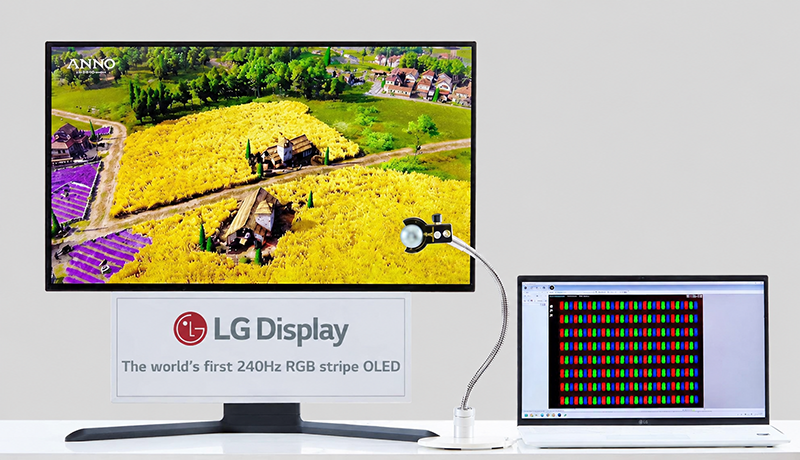
In a press release on 28 May 2026 LG Display confirmed mass production for this panel has now commenced. There is usually a ~3 month lag from panel MP to monitor availability, so our best estimation right now would be around September 2026 for the Asus ROG Swift PG27UCWM which is the only monitor so far announced using this panel. There may be more announced at Computex 2026 next week perhaps too.
Source: LG Display (original Dec 2025) and LG Display (MP, May 2026)
We may earn a commission if you purchase from our affiliate links in this article- TFTCentral is a participant in the Amazon Services LLC Associates Programme, an affiliate advertising programme designed to provide a means for sites to earn advertising fees by advertising and linking to Amazon.com, Amazon.co.uk, Amazon.de, Amazon.ca and other Amazon stores worldwide. We also participate in a similar scheme for Overclockers.co.uk, Newegg, Bestbuy , B&H and some manufacturers.
Stay up to date
Latest News Round-up Video from Computex 2026